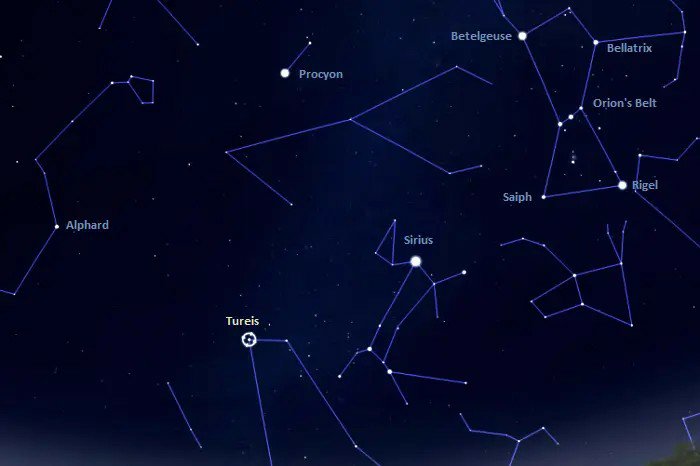
Graphic representation of Tureis rising in eve & Sunrise in morning of the Christmas New year.
The stars align a countdown to every New Year’s Christmas Its a Holiday for Every person in a New Era Nativity
Written in the stars.
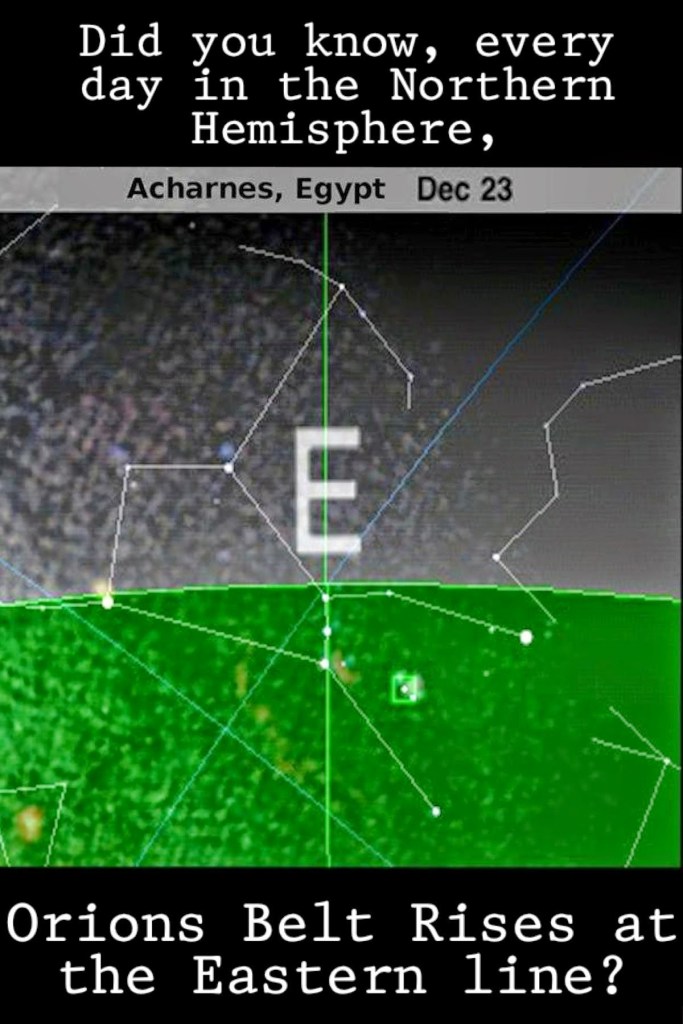
Fixed stars rise in the east, follow the same path, & set in the same location on the horizon every day of the year.
Orion’s belt rises on the Eastern line. The sun follows the same path along the astronomical equator. following Orion’s belt, around the belt of Earth during the Equinoxes.
There were three gifts, which became three kings in the Christian Nativity story. Those three Kings were associated with Orion’s three belt stars.
Follow Orion’s Belt through the Sirius binary system, known as the Dog Star, it is the brightest of the nights fixed stars.
Then find this singular star, (Rho Pup) called Tureis – Arabic for small sheild.
During the month of the winter solstice, the Sun follows the path of Tureis. The Sunrise turns around during a three day period, where it reaches its shortest day, stops moving south & rises northward on the third day. The path of Tureis, the shield is the Sun’s southern boundary.
Starting from Orion’s Belt, 3 stars in a line that rise on the Eastern line, through the brightest star/ 2 stars, to one star that marks the place where the sun will rise on Christmas New Year morning.
HEPNEN is a count down, written in stars, Pointing to the Christmas New Year.
Faith, precisely defined as belief without evidence or reason, can be seen as a deliberate choice to view the world through a distorted lens. This perspective is illustrated through two distinct narratives, various cultural and religious symbols, biblical/dictionary definition, common use & a thought experiment.
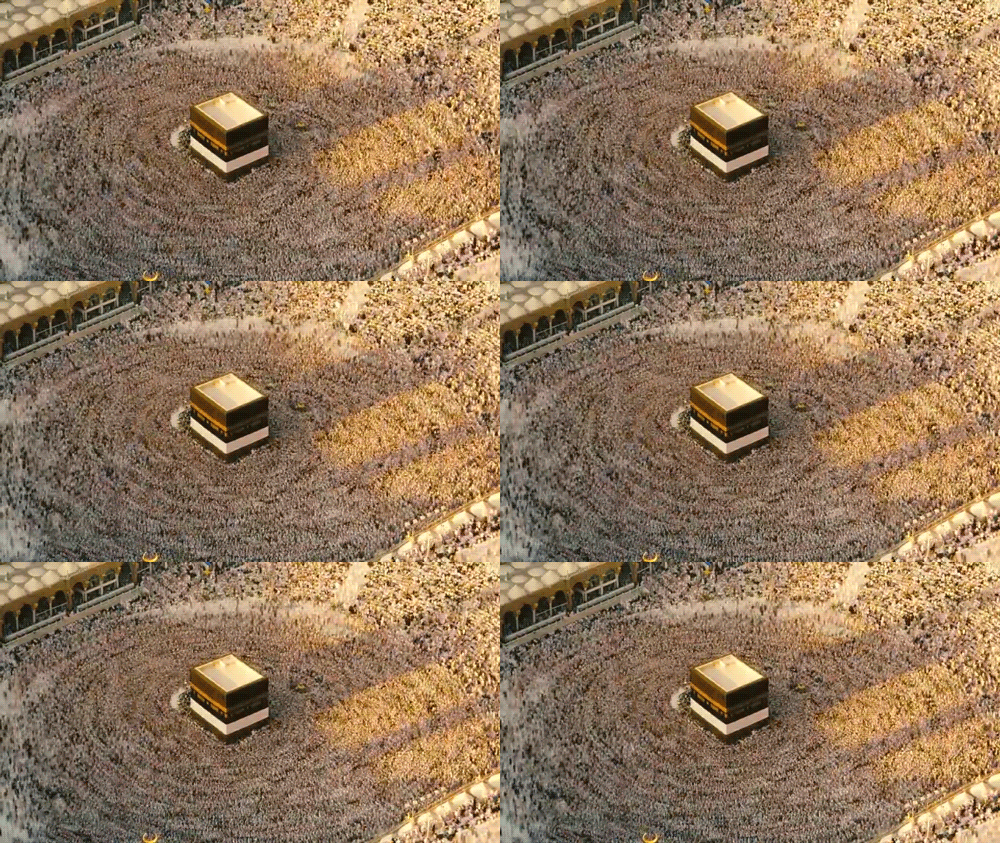
The cube is a recurring symbol in the triad of Abrahmic traditions. The Kaaba in Mecca is a cube,
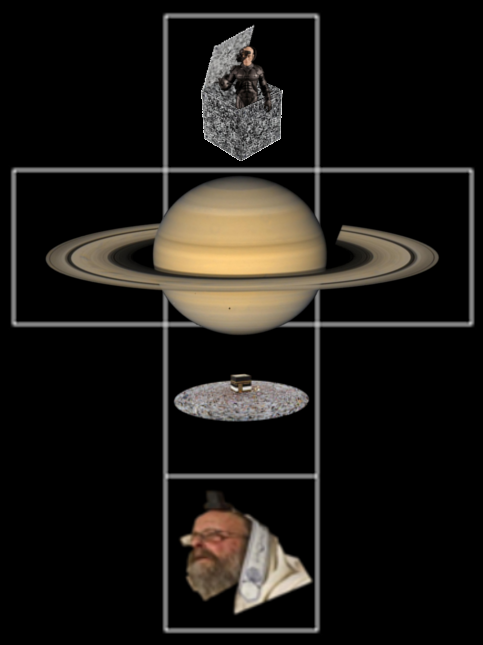
round which Muslims circle, like the rings of Saturn.
Trapped in orbit around the hexagonal north pole of the planet. Islam is the most blatantly restricting of the three today & it’s cube the most obvious.
A hexagon, like the Zionist hexagram shaped Star of David or Seal of Solomon’s geometry implies a cube.
is a cube worn by devout Jews as they bob there heads in reverence at the whaling wall.
Just as the Muslim aims to touch head to cube with his lips. All these cubes associated with the head and free will work to serve toward one meaning.
These symbols suggest minds being arrested by faith, distorting their perception of reality. The cube can be seen as a box for God, an Ark one might say, limited by faith, distorting their perception of reality. The infinite relegated to a mere concept confined to finite human minds. Still, there is more.
In the Book of Revelation, (chapter 21) New Jerusalem—a divine city shaped like a cube—descends from heaven. The faithful interpret this as a sign of divine presence and eternal peace. However, this faith may lead to destruction, as it filters out any skepticism or doubt that might otherwise save the believer & others.
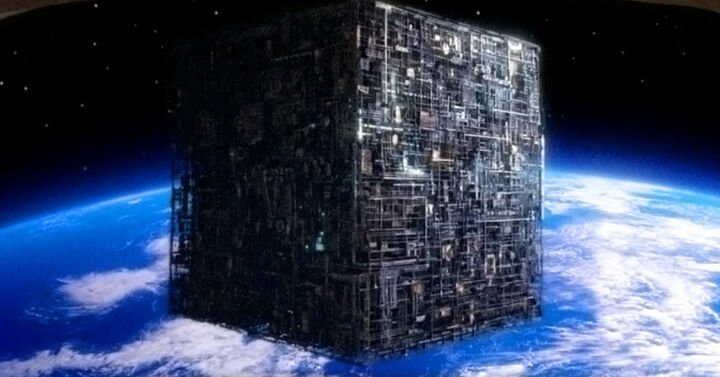
In stark contrast is the Borg invasion from Star Trek. The Borg Collective, driven by a hive-minded faith in unity and perfection, use cube-shaped ships to assimilate other civilizations in the universe.
Here, faith manifests as a collective consciousness that suppresses individuality.
The following thought experiment may be an even more chilling scenario. A rich and powerful man, call him Master Mind Ozluminati, sends a spaceship resembling New Jerusalem. Those whose faith is strengthened by its Biblically divine appearance board the ship, only to be incinerated. All is topsy-turvy when skeptics who question its authenticity survive.
These narratives highlight the dangers of faith. While it can provide hope and unity, it ultimately leads to destruction. Faith leaders use the faith of masses to their own selfish ends every day.
“When you wish upon a star, useful idiot that you are, anything the stars desire, may come through you.”
A jack in the box, is a fool, in a box, with a big head. Is it no accident that the head, the mind the will and it’s walls are emphasized in these cubical references?
Whether it’s the New Jerusalem, the Borg ship, or the deceptive spaceship from the thought experiment, the common factor is a divine cube-shaped object and it’s hive-minded faithful followers. All of these cube stories serve as profound commentaries on the complexities of faith and skepticism in the face of unknown circumstances.
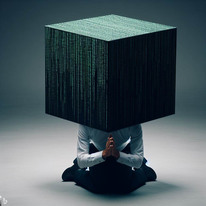
Ultimately, they illustrate that faith is detached from evidence or reason and is inherently folly. Faith acts as both a shield in the battle of ideas and the fabric of an illusory matrix where, dogmatic code is written. It’s like a mime in a box or a jack-in-the-box; it’s the mind in a box—a prison for the mind that cannot be seen, touched, heard smelled or tasted.
Faith is often conflated with Loyalty or devotion, but those words sufficiently represent a dedication to directing one’s self down a narrow path. Two is already too many words for one definition.
We could go through the exact same process to find faith need not be conflated with trust or hope for the same reasons.
The only word in dictionaries that is ever defined as belief without evidence or reason is Faith. It is then left with only two synonyms, lie and delusion. Delusion specifically arrives from a psychiatric disorder, and wouldn’t be taken but for insult. No one would say I have delusion rather than faith. And lie has the same problem. As it stands, Faith is best used to relate a belief without evidence and reason.
In common usage, when people lack evidence for a belief, they often resort to faith. This positions faith as a replacement for reasoning with evidence. It serves as a fallback when empirical evidence is absent, allowing individuals to maintain their beliefs despite the lack of substantiating proof, and often in spite of evidence. The same goes for the loyalty usage of faith, as in faithful spouses etc.
The Bible provides further insight into this concept In Hebrews 11. It describes faith as “the evidence of things not seen,” suggesting that faith acts as stand-in for tangible evidence and reason. It fills the void left by unseen things providing believers with a sense of certainty in absence of verifiable proof.
Furthermore, it refers to faith as “the substance of things hoped for.” This implies that when something is hoped for but not present—and therefore lacking substance—faith steps in to provide that substance. It tells us that faith is non-substance acting as placeholder in absence of evidence and reason.
Finally, it likens faith to a shield, suggesting it serves as mechanism of defense in the ideological battles we face. This metaphor underscores protective role faith can play shielding individuals from doubts and challenges to their beliefs. It is the reason the straw man is a theists most common fallacy in debate. They refuse, by faith, to listen and acknowledge what has been said.
In conclusion these cubical allegories and plain facts illustrate that faith—detached from evidence or reason—is inherently folly acting as shield from alternative ideas and a false map of the territory.
If the matrix is a false reality, imprisoning minds that cannot taste, touch, hear, smell or see it, then faith is the fabric of the matrix, the cubical canvas surrounding consciousness that dogmatic code is written on.
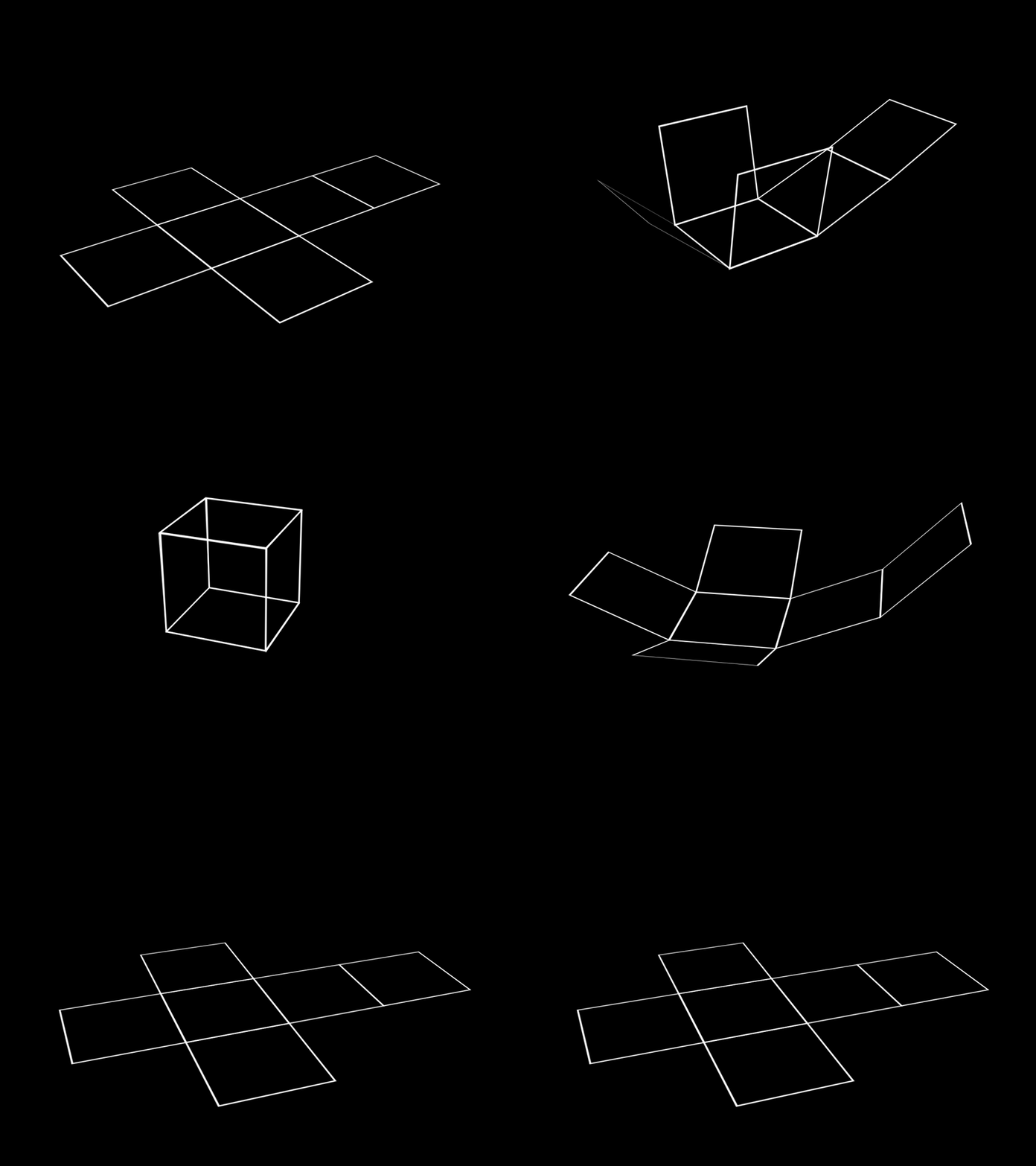
To close, here is one last cubical fact. In a way, Christians carry around an open cube all the time, the cross.






 SYNCPHANY